Autofocus: from curatorial research
to a digital commons
The origins: thinking about images during lockdown (2020–2021)
It all began during the health crisis. As art venues closed their doors and streams of digital images saturated everyday life, Tatiana Patchama, an artist, curator and scenographer from Réunion, asked herself: how can we make people want to look closely at a photographic work in a digital environment where images are swiped, skimmed or “scrolled” past in a matter of seconds? How can we remind them that behind every image lies the intention of its author?
In 2021, Tatiana applied for an 8-month curatorial residency offered by the Fonds régional d’art contemporain (FRAC) de La Réunion. Selected for this research residency, she tested her intuition against the reality of the FRAC Réunion’s photography collection and gradually laid the conceptual foundations of Autofocus.
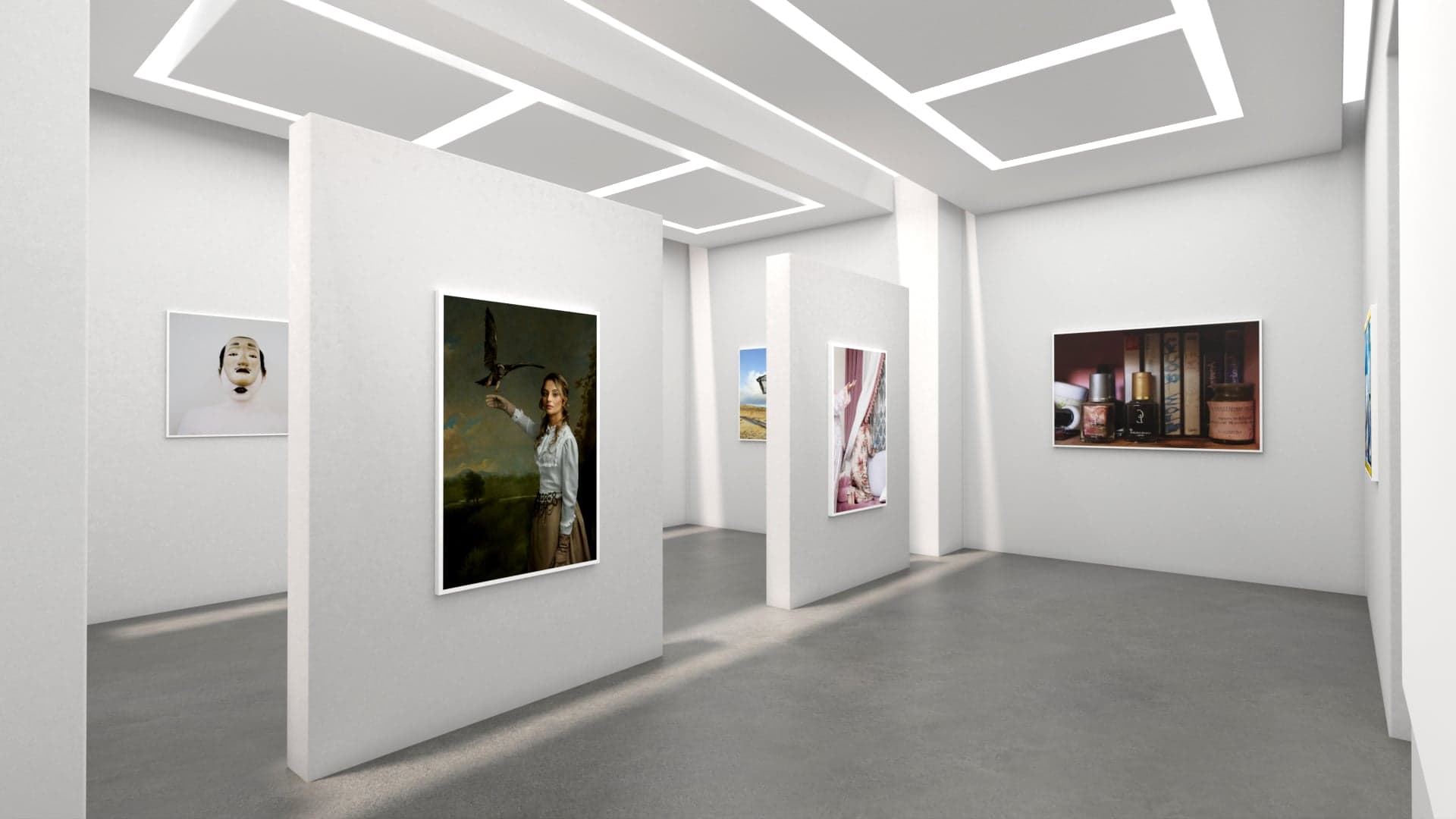
She designed the structure of the game drawing on what happens behind the scenes of exhibition curating and its different stages. Autofocus is designed to reach young audiences, who use digital tools and online games almost every day. The challenge is therefore to offer them an experience that is both playful and demanding, one that captures their attention and draws on their ability to read images, inviting them to observe, choose, compare and weave images into a story to put together their own exhibition.
Putting it to the test: the prototype (2022–2023)
At the end of the residency, funding still had to be raised to develop the digital game. The Fonds régional d’art contemporain then committed its production budget so that the artist could bring Autofocus into the exhibition space and begin a phase of experimentation.
The game came to life through modular wooden furniture and reproductions of photographs mounted on foam board. This version made it possible to test the game mechanics, the stages of exhibition curating and how audiences engage with them in practice.
Tested with school classes and groups, the prototype confirmed the initial intuition: putting participants in an active role sparks their curiosity, creates genuine group dynamics and prompts discussion about the photographs, the artists and visual storytelling. These trials confirmed Autofocus’s potential, validated the principles of the game and provided concrete guidelines for its digital development.
The France 2030 turning point: a shared tool on a national scale (2022)
In 2022, the FRAC Réunion responded to the national call for projects “Digitisation of heritage and architecture”, run by the Caisse des Dépôts et Consignations as part of the France 2030 investment plan.
In 2023, the FRAC Réunion became the only overseas institution to be selected under this national programme.
This financial and institutional recognition changed the scale of the project. Autofocus grew beyond a single-institution tool to become an open, shareable game framework, designed to host image collections from many art and cultural institutions. To bring this interactive tool and its 3D spaces to life, the FRAC entrusted its development and digital engineering to the creative studio Femme Fatale Studio.
Three years of development and international reach (2023–2026)
From 2023 onwards, digital production got under way. The interactive architecture, the user experience and the hanging simulation engines were developed with Femme Fatale Studio, while Designers Unit worked on the graphic identity for external communication and the design of the poster templates.
Designed to circulate as widely as possible, the game is fully bilingual in French and English, making it easier to adopt in educational and cultural networks around the world. Awarded the Ministry of Culture’s label for the Bicentenary of Photography (1826–2026), Autofocus brings together 3 public heritage and contemporary collections from France’s overseas territories, with more than 180 photographs at its official launch on 1 November 2026.
Credits & partnerships
Original concept
Tatiana Patchama, artist, curator and scenographer
Institutional support & Production (FRAC Réunion)
Jean-Christophe Royoux: Director (since 2025)
Béatrice Binoche: Director (2015–2024)
Emmanuelle Schulze: Secretary General (2020–2023)
Anaël Lapierre: Secretary General
Sylvie Bellier: Executive Assistant
Anna Vrinat: Cultural Projects Officer (2022–2025), then Autofocus Development Officer (since 2025)
Laurent Scotta: advice and support (2023–2024)
Digital design, graphic design, development & 3D production (Femme Fatale Studio)
Thibault Jorge : Production Director
Michel Peneau : Technical Director
Arnaud Desjardins : Creative Director
Boris Mobio, Lise Picquette, Maïa Aubague : Project Managers
Thibaud Allie, Matthieu Teyssandier : Web Designers
Maëlle Rabouan, Loïc Quinquenel : Creative Developers
Henry Neira : 3D Artist
Loïc Kessler : Illustrator and Animator
Émilie Valentin : Copywriter
Art direction for external communication and in-game posters (Designers Unit)
Lucie Pindat: Creative Director
External communication copywriting
Claire Bonneton (Les mots singuliers): Copywriter
Partner institutions
FRAC Réunion
Artothèque du Département de La Réunion
Iconothèque historique de l’océan Indien
Public support & funding
France 2030: Operation supported by the French State under the “Digitisation of Heritage and Architecture” programme of France 2030, operated by Banque des Territoires (Caisse des Dépôts group)
Ministry of Culture: Project awarded the label of the Bicentenary of Photography (1826–2026)
Direction des affaires culturelles (DAC) de La Réunion
Région Réunion